



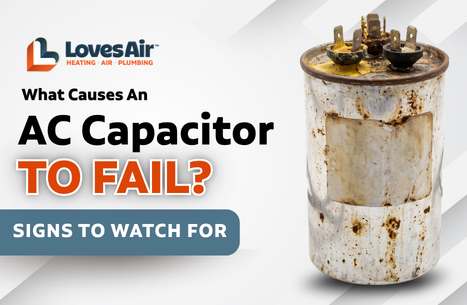
The long, oppressive summer heatwaves in California’s Central Valley can force your air conditioner to work harder than it should. At Loves Air, we know how hard AC systems work during our local 100°F stretches, and a failing capacitor is a common problem many of our customers face. If you’re wondering what causes an AC capacitor to fail, what to look for, and what you can do, your local Loves Air family has the answers.
Loves Air Explains Common Causes and Signs of AC Capacitor Failure
- The AC capacitor provides a steady supply of power to the system’s compressor and fan motors to keep things running smoothly.
- Our extreme Central Valley heatwaves, power surges, and general system strain are common causes of AC capacitor failure.
- Signs of a bad capacitor include warm air from the vents, continuous humming, and system short cycling.
What Does an AC Capacitor Do?
If your air conditioner stops working, the capacitor may be the cause. This part of your AC system is a small electrical component shaped like a cylinder that performs like a powerful battery. It stores energy, then releases it whenever the AC compressor and fan motors need a jolt of power. Once the capacitor kicks on, it continues to provide a constant supply of power to keep the other parts running so your air conditioner can adequately cool your Modesto-area home.
What Causes an AC Capacitor to Fail?
Several things can cause your AC capacitor to fail, including:
- Extreme heat: When it’s been over 100 for a few days straight, your system is working overtime, which can dry out and degrade the internal materials of the heat-sensitive capacitor.
- Power surges: Whether caused by a lightning storm or a power grid fluctuation during a long California heatwave, major surges can overload the capacitor and cause it to short out or become damaged.
- Age: If you’re wondering whether to repair or replace your 15-year-old AC, a common concern is that years of wear and tear have caused the capacitor to fail, resulting in system failure.
- Damage: Exposure to excessively high humidity or moisture in the environment around your AC can corrode internal components, disrupting the electrical connection that powers the capacitor.
How Can You Tell If a Capacitor Is Bad?
At Loves Air, we genuinely care about our customers and community and want to help with your air conditioner problems. Before you call us, it’s important to know how to tell if a capacitor is bad. Here are some signs of a bad capacitor to be aware of:
- The top or bottom of the capacitor is bulging and has a rounded or domed shape.
- You notice an oily residue or other liquid leaking from the top or sides of the metal casing.
- Black spots or dark discoloration are visible on the casing or on your AC’s electrical terminals.
- Your outdoor condenser unit hums loudly, but the fan motor has stopped spinning.
- It takes a significantly long time for your AC to kick on after the thermostat signals it to start cooling your home.
- Warm or hot air blowing from the vents is a common sign, as a bad capacitor can cause the AC to not cool your home.
- Your AC turns on briefly, then shuts off again before cooling your home (short cycling).
Will a Bad Capacitor Cause Your AC to Not Cool?
The Loves Air family takes pride in helping Modesto homeowners stay comfortable year-round, and we encourage our customers to be proactive about their air conditioners’ performance. So, what happens when an air conditioner capacitor goes bad? In most cases, your AC will run, but there won’t be any cold air coming from the vents, or the unit may not turn on at all. You might also notice a loud humming sound as the motor tries to start but fails to do so.
Why Modesto Summers Are Especially Hard on AC Capacitors
Summers in the 209 are extremely hot, which puts a lot of stress on AC capacitors as equipment runs continuously, sometimes for 10 to 14 hours a day. The longer your AC runs, the hotter the capacitor gets, and high energy demand in our region may also cause power surges that push the capacitor to its limits, requiring professional repair. Cottonwood snow that lasts through July and dust from the agricultural areas in the Central Valley can clog condenser coils, restrict airflow, and overwork the capacitor.
What to Do If You Suspect a Bad Capacitor
If you suspect a bad capacitor, turn off your AC at the thermostat and main circuit breaker. Between the summer heat and daily use, it’s normal for the AC in your Modesto home to need a little extra attention over time. Once you’ve turned the AC off, get in touch with us, and we’re happy to take a look to help you decide whether a repair or replacement is needed.
Contact Loves Air and Put a Little Love in Your Home!
If you live in the Central Valley, we’d like to welcome you to the Loves Air family. Whether it’s a failing capacitor or another issue, find out why we’re the best in The 209, and why you’ll love us, guaranteed, by reaching out today.
Frequently Asked Questions
Can I replace an AC capacitor myself?
We don’t recommend attempting to replace an AC capacitor yourself, as this component stores a large electrical charge, even after power is disconnected. If you suspect an issue with your AC capacitor, reach out to us, and we’ll come take a look.
How long do AC capacitors last?
On average, AC capacitors last between 5 and 10 years or longer under ideal conditions. In our region, most capacitors have a lifespan of around three to seven years due to our intense, long heatwaves and prolonged periods of constant AC usage.
How much does it cost to replace an AC capacitor?
The cost to replace an AC capacitor varies based on factors like labor costs and the part itself. Dual-run capacitors that run the fan and compressor continuously tend to cost more than start capacitors, which only provide a brief surge to jumpstart the fan and compressor.